How the state’s new Hate Speech and Hate Crimes Bill revives old authoritarian instincts of the party
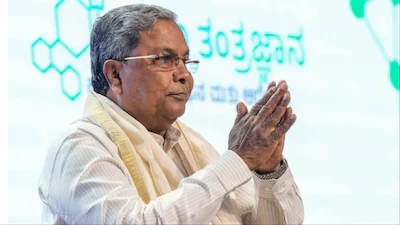
Pic – What the Siddaramaiah government has now approved in the cabinet is not a defence of harmony; it is a draconian measure towards a police state which curbs speech, thought, association, and even emotion.
Karnataka’s new Hate Speech and Hate Crimes Bill comes clothed in the language of curbing “hate speech” and preserving “harmony”. It speaks of dignity, equality, and safety. But what the Siddaramaiah government has now approved in the cabinet is not a defence of harmony; it is a draconian measure towards a police state which curbs speech, thought, association, and even emotion. Congress had earlier tried this with Section 66A of the IT act, which was struck down by the Supreme Court. The new Bill resurrects it.
To understand the magnitude of this move, begin with the definition the bill rests on. “Harm,” we are told, includes any emotional, psychological, physical, social or economic harm. Any emotional harm. Any psychological harm. Any social harm. Under such a definition, a political argument becomes a prosecutable injury. A meme becomes a legal offence, a joke a potential violation. A sarcastic remark becomes a crime of the mind. If one wants to escape “emotional harm” one shouldn’t be on social media. Or even in a family. Anything can be said to cause “emotional harm”—from a teacher’s admonition to a mother’s scolding. The bill’s own existence causes emotional harm to every citizen who now has to second-guess each post, each forward, each retweet, wondering if a magistrate—or more likely a police constable—will deem it injurious.
If this is the standard, the government should arrest itself first. Of course, the government realises that so it first exempts itself: “No suit, prosecution or other legal proceedings shall lie against any officer or authority of the government.”
From this bizarre foundation the bill criminalizes a vast, undefined territory of expression. Anyone who “publishes, propagates or advocates” anything that could be construed as intending to “harm or incite harm or promote or propagate hatred” risks three years in jail. Three years, non-bailable, for a post on social media. And “hatred” here is not a term of art with precise meaning; it is whatever an offended party, vindictive politician or an overzealous policeman wants it to be. The police do not need to show violence, or incitement to violence, or even a clear and present danger. Hurt feelings are enough.
This alone violates the Supreme Court’s ruling in Shreya Singhal v. Union of India (2015), which struck down the infamous UPA-era Section 66A of the IT Act. In that landmark judgement, the Court held that vague, subjective categories like “offensive,” “annoying,” or “inconvenient” speech were unconstitutional. Restrictions on speech must be tightly drawn and linked directly to incitement to violence—not to emotional discomfort. Karnataka’s bill not only revives the very vagueness the Court condemned, it expands it. If 66A punished annoyance, Karnataka punishes emotion itself.
Worse than what you say, however, is what you forward. Section 7 of the bill introduces a new frontier in thought-policing: the criminalisation of unknowing assistance. Any person who knowingly or unknowingly believes that an act would be an offence and “aids, abets or assists” in it—by forwarding a message, sharing a video, retweeting a link—may be imprisoned for up to three years. The bill helpfully clarifies that the aider or abettor may be acting “in a location remote from the scene of the crime.” In other words: you can be sitting in Mysuru or Mumbai or Melbourne, forwarding something you didn’t write, and you can be prosecuted.
Forwarding a WhatsApp message has now become a potentially criminal act if a politician, activist, or community group claims emotional injury. Even 66A never dreamt of such reach. Karnataka has managed to make the digital act of reading and sharing information itself suspect.
The bill then creates a sweeping administrative machinery to restrict movement, gatherings, processions, and sound if “in the opinion” of the District Magistrate such acts may cause “apprehension in the minds of a community” or disturb the “preservation of peace or harmony between different groups, castes or communities” or affect “public safety or maintenance of public order.” Note the incentive structure hidden here. The more easily a group claims to be disturbed, the more swiftly the state will spring to its defence. So the state can proactively ban Ramanavami processions out of concern for “public safety” because people of some other community may throw stones.
This reverses the protection due from the state for victims and empowers the aggressors. Communities that threaten violence at perceived slights will enjoy maximal sensitivity from the administration. Those that do not riot, hence do no express that they experience “emotional harm” will be treated as safe to ignore. In effect, the bill rewards aggression and volatility. It incentivises mob rule.
The Congress government would like us to believe this legislation protects minorities. It does not. It empowers the most aggressive actors within any community. It creates a marketplace for offence, where the state becomes the guarantor of the emotional fragility of those most willing to shout and create a ruckus. A truly enlightened administration would reverse this—be strict with those who create public harm due to perceived offence or slight.
In classic Congress fashion, the bill comes with exemptions that reveal its real political commitments. The law explicitly protects: “the bona fide interpretation and proselytisation or espousing of any religious tenet…”
Missionary activity, in other words, is fully shielded—a Hindu is not allowed to claim that proselytisation causes emotional and social harm to the community. As Swami Dayananda Saraswati of Arsh Vidya Gurukulam said in respect of conversion: “This is wrong because if one Hindu or Jew or a Parsi is converted, and the other members of the family are not converted, they are all hurt. Even the converted one must be hurt underneath… What do you call this act that hurts? I call it violence. It is not ordinary violence. It is violence to the deepest person, the core person, in the human being.”
The framers of the bill appear well-aware that Christian proselytisation creates both emotional and social harm since they have specifically excluded it from the provisions of the bill. If it doesn’t create harm, what would be the need to create a special exclusion for it?
But criticism of missionary activity, or questioning aggressive proselytisation tactics, or even satirising religious doctrines could be considered harm under the bill. If “espousing of any religious tenet” is considered protected speech, why is criticizing that religious tenet “hate speech”? Hurt emotions in one direction count as a crime; in the other direction they count as religious freedom. Just because “unbelievers” won’t riot, calling unbelievers “the worst of creatures” is ok because it is found in a religious book? Secularism of this variety is not neutrality; it is a calibrated shield for Congress’ favoured constituencies.
It’s not that BJP hasn’t misused speech laws or strengthened problematic ones, such as certain SC/ST Act provisions. Indian politicians of all hues are seduced by the allure of controlling discourse and having the power to jail people at will. But there is a difference between opportunistic misuse and ideological commitment. The Congress has consistently, from Nehru’s First Amendment of 1951 to Indira’s Emergency to UPA’s 66A, championed the cause of speech suppression as moral duty. Karnataka’s bill reflects a lineage of Congress’ totalitarian tendencies.
The irony is that India does not need more speech laws; it needs fewer. Curbing speech is Abrahamic—the very impulse that once criminalised heresy now resurfaces as ‘hate speech’ regulation. The same mindset that burned dissenters at the stake now proposes criminal penalties for emotional injury. The bridge back to India is simply this—Karnataka has imported a worldview alien to our civilisation, one that mistakes coercion for order and sentiment-policing for peace. We are a dharma civilisation, not a policing civilisation. The West, rooted in Biblical law-making, has centuries of criminalising heresy and blasphemy—crimes against doctrine, not against persons. For a thousand years, the Church wielded the machinery of punishment to enforce orthodoxy. The dissenting mind was a criminal mind. It took the Protestant Reformation and the long, bloody European struggle for liberty before Western societies slowly clawed back the right to disagree without being burned, jailed, or excommunicated. That historical memory still shapes Western legal instinct: morality is to be legislated, deviation to be punished.
India, by contrast, believed morality emerged from cultivation of character—samskara, not censorship. Our civilisation survived millennia of debate, disagreement, satire, even vilification, without criminalising emotional harm. We have playfully mocked our gods in folk theatre, lampooned kings in poetry, and debated metaphysics across schools without needing a police constable to enforce “harmony.” The new “secular” hate speech laws resurrect, in sanitized form, the old European apparatus of heresy and blasphemy—anxious to protect doctrines and sentiments rather than people. In a strange throwback to the Dark Ages, Karnataka now proposes to punish not violence but deviation from approved feeling.
The Congress insists that speech must now be regulated to maintain order. But order imposed through fear is not order; it is paralysis. The bill will not create harmony. It will create a silenced society, terrified of expression, wary of humor, suspicious of debate, and permanently vulnerable to the emotional blackmail of whichever group threatens to riot first. This is already the case in India due to Nehru’s first anti-liberal speech-curbing amendment; the bill will only make it worse.
Thankfully, the bill is not yet law, and Karnataka still has a constitutional safety valve. It has been passed by the Karnataka Assembly—where the Congress enjoys a majority—but it still awaits scrutiny in the Legislative Council, where the numbers do not favour it. It must then secure the Governor’s assent. And when challenged, as it will be, it must survive constitutional review. On every count—vagueness, overbreadth, lack of proximity to incitement, chilling effect—it fails the Shreya Singhal test. The Supreme Court has struck down better-written laws than this one.
Every such law is creating a sword for the state. A law that criminalizes emotion will be used not to protect the weak but to target the inconvenient. A law that punishes forwarding messages will not curb hate; it will curb dissent. A law that rewards communities that riot easily will not build harmony; it will build extortion-by-agitation.
We do not need new speech laws. What we need is a vigilant citizenry willing to defend dissent itself—the cornerstone of any society that wishes to remain free. We need an old-fashioned virtue: the courage to tolerate speech we dislike. Karnataka’s bill abandons that principle. It does not preserve harmony; it creates performative harmony while sowing fear. It is not a defence of dignity; it is an attack on liberty. And once such laws take root, they are rarely abrogated. Which of the many earlier draconian laws has the BJP withdrawn?
If Karnataka falls to this new authoritarianism, other states will follow. The only force that can stop it now is public resistance, legislative scrutiny, and judicial clarity. The Congress has revived the spirit of 66A. It is up to the rest of India to bury it again.
Originally Published on news18.com