The violence in Bengal is not just a past horror. It is a reminder of what happens when a civilisation is disarmed by its own slogans
Pic – The Kashmir Files tore open the wound of a genocide that the nation pretended never happened. File image
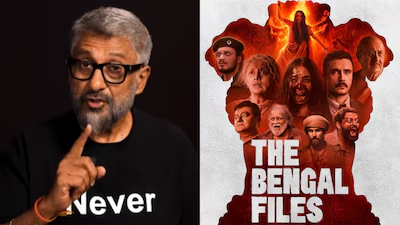
Vivek Agnihotri keeps pulling skeletons out of cupboards India would rather keep locked. The Tashkent Files poked at a suspicious death. The Kashmir Files tore open the wound of a genocide that the nation pretended never happened. Now The Bengal Files turns to a darker chapter still—the cycles of violence that Hindus in Bengal endured, and the studied silence that followed.
This is Agnihotri’s most accomplished work yet. The pacing is tighter, the characters richer, the narrative unrelenting. Yet, ironically, the film has not reached the same cult status that The Kashmir Files did. If you haven’t seen it, then you need to go ahead and see it. Perhaps that itself is telling. India is still not prepared to confront the reality of its effete slogans like “secularism” and come to terms with the real blood-stained, inconvenient, and unsanitised past.
The power of the film lies in its reclamation of memory. Gopal Patha, for instance, a real figure, who organised Hindu resistance during the Great Calcutta Killings of 1946. When the state became complicit in the killings of Hindus, Gopal stood up and organised a fightback so his people could survive. A hero by any standard. And yet his name is absent from our textbooks, absent from our national consciousness. That silence is not accidental. It is the result of decades of carefully curated history, where the courage of Hindus defending themselves was erased and replaced with a narrative of victimhood and platitudes about ahimsa.
Those platitudes—what else to call them but shibboleths? “Secularism”. “Non-violence”. Slogans repeated like mantras, while Hindu neighbourhoods burned. The violence in Bengal was not random rioting. It was systematic: rapes, killings, and expulsions with the aim of causing a Hindu exodus. And against such zealotry, what protection did Gandhi’s insistence on unilateral disarmament of Hindus offer? None. On the contrary, it disarmed the victims while emboldening the aggressors. The high ground is the graveyard, and Gandhi was happy to be the hijra clapper providing the lamentation for the funerals.
This tension is captured brilliantly in Pallavi Joshi’s performance as Maa Bharti. In her younger version, Bharti Mukherjee is played by Simrat Kaur Randhawa. Her character is an intellectual clinging to ideals even as reality tears those ideals to shreds. She is empathetic, conflicted, and desperate to reconcile what she believes with what she sees. As Maa Bharti, the inner torment of Pallavi’s character, whose idealism is shattered, voices the cry of a society too enchanted by its slogans till reality comes knocking, brutally, at its doorstep.
Agnihotri also brings in Amarjeet Arora, played by Eklavya Sood, who anchors the story in a wider Indic experience. Partition was not Bengal’s tragedy alone; Sikhs bore its horrors in Punjab. In the fake narratives of today, it is a worthy reminder that Hindus, Sikhs, and Dharmic communities together bore the brunt of Islamic religious fanaticism across the subcontinent. The one strangely false note was Mithun Chakraborty holding up religious artifacts from Hindu and Muslim victims and lamenting he couldn’t find the Indian in them. But wasn’t finding the Indian exactly the secular problem the film tries to deconstruct?
That the film itself has faced bans and censorship attempts is no surprise. West Bengal, of all places, should have seized the opportunity for honest reckoning. Instead, it chose the familiar path—silence, suppression, denial. In this, too, the film reflects history: the voices that try to tell the truth in India are often the ones most quickly gagged by the thekedars of the same secularism that enabled the Hindu genocides in the first place.
What lingers after the credits is not catharsis. There is no neat closure, no comforting moral, and no superhero saviour. The story remains unfinished, the wounds raw. That is the point. The violence was not resolved by the Partition. Nor has it been resolved in the decades since. The violence and the sound of secular silence and denial continue.
When I watched The Bengal Files, I thought I had processed it. But two mornings later, I woke up still turning over its images in my mind—haunted not only by the brutality but also by the silence that followed. We’d earlier published the book Bengal’s Hindu Holocaust: The Partition of India & Its Aftermath by Sachi Dastidar, which documents the genocide through detailed facts and figures. But the film hits home viscerally. This is what Agnihotri has done: taken what was confined to history books, read only by a few, and thrust it into the nation’s bloodstream.
But there lies the real story. The violence in Bengal is not just a past horror. It is a reminder of what happens when a civilisation is disarmed by its own slogans. We were told to chant “secularism” while mobs sharpened their knives. We were told “ahimsa” was our shield while women were raped and burnt alive, and families were uprooted. These were not ideals; they were alibis—excuses to do nothing while Hindus bled.
This hypocrisy still defines our public life. The reality of Islamic aggression is buried, the genocides of Hindus reduced to footnotes, while we continue to tell ourselves comforting lies. Lies that leave us just as unprepared to deal with the present, and blind to the future that is coming. And make no mistake—the “secular” Indian intellectuals who manufactured these lies are not innocent bystanders. They are complicit in their own genocide.
That is the real sting of The Bengal Files. Not that it resurrects a forgotten past, but that it rips the secular niqab off the present. It forces us to ask: will we continue to bury our dead wrapped in shrouds of slogans, or will we finally find the courage to confront the truth?